Part Of Business
Letters
· The Heading (The Retern Address) or Letterhead - Companies
usually use printed paper where heading or letterhead is specially designed at
the top of the sheet. It bears all the necessary information about the
organisation’s identity.
· Date - Date of writing. The month should be fully spelled
out and the year written with all four digits October 12, 2005
(12 October 2005 - UK style). The date is aligned with the return address. The number of the date is pronounced as an ordinal figure, though the endings st, nd, rd, th, are often omitted in writing. The article before the number of the day is pronounced but not written. In the body of the letter, however, the article is written when the name of the month is not mentioned with the day.
(12 October 2005 - UK style). The date is aligned with the return address. The number of the date is pronounced as an ordinal figure, though the endings st, nd, rd, th, are often omitted in writing. The article before the number of the day is pronounced but not written. In the body of the letter, however, the article is written when the name of the month is not mentioned with the day.
·
The Inside Address - In a business or formal letter
you should give the address of the recipient after your own address. Include
the recipient's name, company, address and postal code. Add job title if
appropriate. Separate the recipient's name and title with a comma. Double check
that you have the correct spelling of the recipient 's name.
The Inside Address is
always on the left margin. If an 8 1/2" x 11" paper is folded in
thirds to fit in a standard 9" business envelope, the inside address can
appear through the window in the envelope.
· The Greeting - Also called the salutation. The
type of salutation depends on your relationship with the recipient. It normally
begins with the word "Dear" and always includes the person's last
name. Use every resource possible to address your letter to an actual
person. If you do not know the name or the sex of of your reciever
address it to Dear Madam/Sir (or Dear Sales Manager or Dear Human Resources
Director).As a general rule the greeting in a business letter ends in a
colon (US style). It is also acceptable to use a comma (UK style).
· The Subject Line (optional) - Its inclusion
can help the recipient in dealing successfully with the aims of your letter.
Normally the subject sentence is preceded with the word Subject: or Re: Subject
line may be emphasized by underlining, using bold font, or all captial letters.
It is usually placed one line below the greeting but alternatively can be
located directly after the "inside address," before the
"greeting."
·
The Body Paragraphs - The body is where you explain
why you’re writing. It’s the main part of the business letter. Make sure the
receiver knows who you are and why you are writing but try to avoid starting
with "I". Use a new paragraph when you wish to introduce a new idea
or element into your letter. Depending on the letter style you choose,
paragraphs may be indented. Regardless of format, skip a line between
paragraphs.
· The Complimentary Close - This short, polite closing ends
always with a comma. It is either at the left margin or its left edge is in the
center, depending on the Business Letter Style that you use. It begins at the
same column the heading does. The traditional rule of etiquette in
Britain is that a formal letter starting "Dear Sir or Madam" must end
"Yours faithfully", while a letter starting "Dear " must
end "Yours sincerely". (Note: the second word of
the closing is NOT capitalized)
· Signature and Writer’s identification - The signature
is the last part of the letter. You should sign your first and last names. The
signature line may include a second line for a title, if appropriate. The
signature should start directly above the first letter of the signature line in
the space between the close and the signature line. Use blue or black ink.
·
Initials, Enclosures, Copies - Initials are
to be included if someone other than the writer types the letter. If you
include other material in the letter, put 'Enclosure', 'Enc.', or ' Encs. ', as
appropriate, two lines below the last entry. cc means a copy or copies are sent
to someone else.
Style
Of Business Letter
Business
letter can be written with different styles, such as:
·
Full Block.
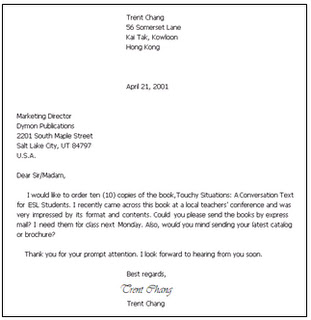
Full block style is a
letter format in which all text is justified to the left margin. In block
letter style, standard punctuation is placed after salutations and in other
headings. Open punctuation, however, refers to a modification of style where
all nonessential punctuation is omitted. A few key factors will help you
understand block style format and the difference that open punctuation makes.


1.
Return Address: If your stationery has a
letterhead, skip this. Otherwise, type your name, address and optionally, phone
number. These days, it’s common to also include an email address. 2.
Date: Type the date of your letter two to six lines below the
letterhead. Three are standard. If there is no letterhead, type it where shown.
2. Reference Line: If the recipient specifically requests
information, such as a job reference or invoice number, type it on one or two
lines, immediately below the Date.
3. Special Mailing Notations: Type in all uppercase characters,
if appropriate.
4. On-Arrival Notations: Type in all uppercase characters,
if appropriate. You might want to include a notation on private correspondence.
5. Inside Address: Type the name and address of the
person and/or company to whom you’re sending the letter, three to eight lines
below the last component you typed. Four lines are standard.
6. Attention Line: Type the name of the person to
whom you’re sending the letter.
7. Salutation: Type the recipient’s name here. Type
Mr. or Ms. [Last Name] to show respect, but don’t guess spelling or gender.
8. Subject Line: Type the gist of your letter in
all uppercase characters, either flush left or centered. Be concise on one
line.
9.
Body: Type two spaces between sentences. Keep it brief and
to the point.
10. Complimentary Close: What you type here depends on the
tone and degree of formality.
11.
Signature Block: Leave four blank lines after the
Complimentary Close to sign your name. Sign your name exactly as you type it
below your signature. Title is optional depending on relevancy and degree of
formality.
12. Identification Initials: If someone typed the
letter for you, he or she would typically include three of your initials in all
uppercase characters, then two of his or hers in all lowercase characters.
13.
Enclosure Notation: This line tells the reader to
look in the envelope for more. Type the singular for only one enclosure, plural
for more.
14.
cc: Stands for courtesy copies (formerly carbon copies).
List the names of people to whom you distribute copies, in alphabetical order.
·
Semi-block style
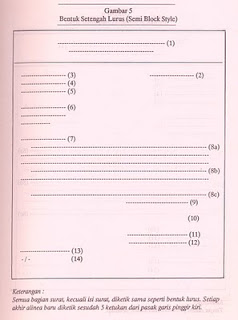
Semi-blok fromat: in
a format this text parallel left and all paragraphs in the letter is indented.
Format shape on this letter on letter head, date, complementary a close, and
signature being in a position flattened right. In the layout uneven right, but
can dibilangg flattened middle. Other parts on a letter as inside address,
subject, salutation, body of letter, and enclosure if terdapatnya attachment
letter,Being flattened on the left.
Sample Form Letter
Semi Block Style :

Description:
1.
Kop
Letter
2.
Date
of preparation of letters
3.
Letter
No.
4.
Attachment
5.
Case
6.
The
letter addressed
7.
A
word of salutation
8.
Introduction
letter (8a)
9.
Explanation
letter (8b)
10. The cover letter (8c)
11. Greetings Closing (9)
12. Name of office (10)
13. Signature (11)
14. Names to approach
(12)
15. Copy (13)
16. Attachment page
letter / initials (14)

·
Simplified-style
Simplified-style
business letters contain all the same elements as the full-block and semi-block
letters. Like the full-block format, the simplified format left-justifies every
line except for the company logo or letterhead. The date line is either
slightly right of center or flush with the center of the page. Letters written
in the simplified format have fewer internal sections, such as the body,
salutation and date line.
Using the simplified
style is the most useful at times when you don’t have a recipient’s contact
name. Because the simplified style does not require a salutation, you don’t
need the person’s name. The simplified format does away with unneeded formality
while maintaining a professional approach.

·
Hanging-Indented Style
This very useful
style places the first words of each paragraph prominently on the page. It is
useful for letters that deal with a variety of different topics. However, for
normal business communications, this style is very rarely used. The first line
of the paragraph begins at the left-hand margin. And the other lines of the
same paragraph are indented three to four spaces. This is the reversal of
semi-indented style discussed in other page.

Source: